
sexta-feira, 22 de abril de 2022

segunda-feira, 11 de abril de 2022
Lab equipment - final exercise
Choose one of the following pictures and describe it at the end of your PowerPoint.
1 - What are they doing?
2 - What equipment are they using?



segunda-feira, 4 de abril de 2022

quinta-feira, 24 de março de 2022
Talking about here and now - Present Continuous
http://www.grammarnet.com/ghtml/prescont.htm

Exercícios:
Exercise 1
Exercise 2
Exercise 3
Exercise 4
Present simple or present continuous?
segunda-feira, 21 de março de 2022
A Laboratory analyst routine
1 - What does a Laboratory analyst do?
2 - Look for pictures to illustrate your Sentences.
3 - Describe the routine o an analyst using the linking words (1) and the frequency adverbs (2).
1 - Linking words
First: Primeiro
Second: Segundo
Third: Terceiro
After: Depois
After That: Depois disso
Then: Então
Finally: Finalmente
2 - Frequency adverbs
 Exercise 1
First: Primeiro
Second: Segundo
Third: Terceiro
After: Depois
After That: Depois disso
Then: Então
Finally: Finalmente
2 - Frequency adverbs

segunda-feira, 21 de fevereiro de 2022
Th negative form of present simple
To make a negative sentence in English we normally use Don't or Doesn't with all verbs EXCEPT To Be and Modal verbs (Can, might, should etc.).
Affirmative: You speak Spanish.
Negative: You don't speak Spanish.
Negative: You don't speak Spanish.
You will see that we add don't between the subject and the verb. We use Don't when the subject is I, you, we or they.
Affirmative: He speaks Spanish.
Negative: He doesn't speak Spanish.
Negative: He doesn't speak Spanish.
When the subject is he, she or it, we add doesn't between the subject and the verb to make a negative sentence. Notice that the letter S at the end of the verb in the affirmative sentence (because it is in third person) disappears in the negative sentence. We will see the reason why below.
Contractions
Don't = Do not
Doesn't = Does not
Doesn't = Does not
I don't like fish = I do not like fish.
There is no difference in meaning though we normally use contractions in spoken English.
Word Order of Negative Sentences
The following is the word order to construct a basic negative sentence in English in the Present Tense using Don't or Doesn't.
| Subject | don't/doesn't | Verb* | The Rest of the sentence |
|---|---|---|---|
| I / you / we / they | don't | have / buy eat / like etc. | cereal for breakfast |
| he / she / it | doesn't |
*Verb: The verb that goes here is the base form of the infinitive = The infinitive without TO before the verb. Instead of the infinitive To have it is just the have part.
Remember that the infinitive is the verb before it is conjugated (changed) and it begins with TO. For example: to have, to eat, to go, to live, to speak etc.
Examples of Negative Sentences with Don't and Doesn't:
- You don't speak Russian.
- John doesn't speak French.
- We don't have time for a quick drink.
- It doesn't rain much in summer.
- They don't want to come with us.
- She doesn't like meat.
EXERCISES
quarta-feira, 16 de fevereiro de 2022
Present simple for routines
1 - The present simple affirmative
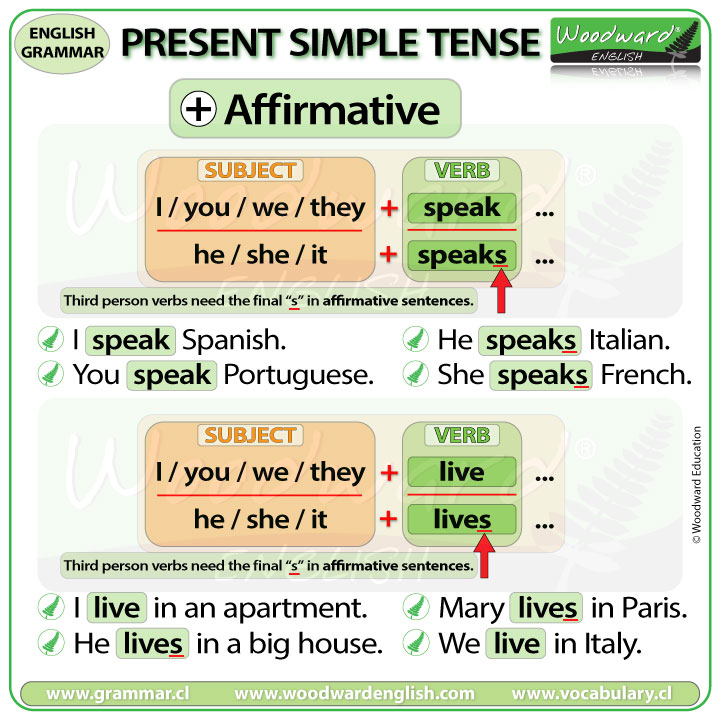
| Na afirmativa somente na 3ª pessoa do singular (he, she, it) do Present Simple adiciona-se -s ou -es à base do verbo. |
| (a) quando a base do verbo termina em -o, -s, -sh, -ch, -x, -z adiciona-se -es : |
| Base | -es Form | Significado |
| go | goes | ir |
| kiss | kisses | beijar |
| wash | washes | lavar |
| watch | watches | observar; ver |
| mix | mixes | misturar |
| buzz | buzzes | zumbir |
| (b) quando a base do verbo termina em consoante + -y, converte-se o -y em -i, e adiciona-se -es a seguir: |
| Base | -ies Form | Significado |
| carry | carries | carregar; levar |
| cry | cries | chorar; gritar |
| study | studies | estudar |
| photocopy | photocopies | fotocopiar |
| (c) às restantes bases de verbos, adiciona-se -s : |
| Base | -s Form | Significado |
| play | plays | brincar; jogar; tocar |
| enjoy | enjoys | divertir-se; desfrutar |
| swim | swims | nadar |
| dance | dances | dançar |
| write | writes | escrever |
| read | reads | ler |
| (d) excepção: |
| Base | -s Form | Significado |
| have | has | ter; comer; tomar |
| |
|---|
Estudem este link: Regras do Simple Present
3 - Realizem os exercícios seguintes:
Affirmative
Exercises:
Exercise 1
Exercise 2
Exercise 3
Exercise 4
4 - Final exercise
3 - Realizem os exercícios seguintes:
Affirmative
Exercises:
Exercise 1
Exercise 2
Exercise 3
Exercise 4
4 - Final exercise
Subscrever:
Mensagens (Atom)